Equilibrium Studies
Series Introduction
The Equilibrium Studies examine painting as a material system negotiating gravity, pressure, and internal tension.
Pigment accumulates until weight approaches instability. Embedded structures introduce resistance, redistributing force across the surface.
Form emerges not from expression, but from moments of temporary balance—when matter holds, yields, and stabilizes under load.
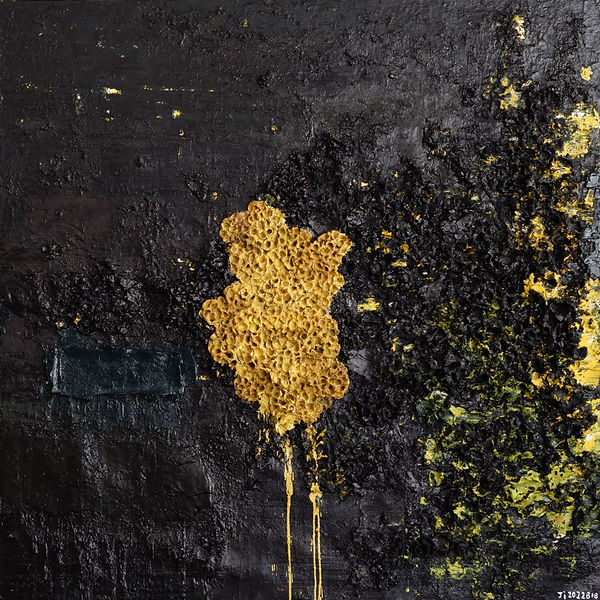
Under Gravity (2024)
Dimensions: 8 × 8 ft
Oil paint, stainless-steel mesh, mineral powder, canvas on plywood
Material descends under sustained load.
Resistance within the structure redistributes force, allowing balance to emerge.

Tension Fold (2024)
Dimensions: 8 × 8 ft
Oil paint, stainless-steel mesh, mineral powder, canvas on plywood
Material bends under competing forces.
The fold forms where resistance and gravity meet.

Rift Embers (2024)
Dimensions: 8 × 8 ft
Oil paint, stainless-steel mesh, mineral powder, canvas on plywood
Heat-like residues remain after compression.
Surface tension settles into a quiet but active equilibrium.

Fracture Field I (2024)
Dimensions: 8 × 8 ft
Oil paint, stainless-steel mesh, mineral powder, canvas on plywood
Compression reaches its threshold.
Fissures appear as structural responses, not as failure.

Fracture Field II (2024)
Dimensions: 8 × 8 ft
Oil paint, stainless-steel mesh, mineral powder, canvas on plywood
Accumulated pressure reorganizes the surface through branching rupture.
The fracture redirects tension, restoring temporary balance within the field.

Fracture Field III (2024)
Dimensions: 8 × 8 ft
Oil paint, stainless-steel mesh, mineral powder, canvas on plywood
Internal force concentrates before release.
Rupture marks the moment when instability converts into structure.

Dark Pulse (2024)
Dimensions: 8 × 8 ft
Oil paint, stainless-steel mesh, mineral powder, canvas on plywood
Dense layers compress inward, darkening under sustained weight.
Rhythm persists beneath the surface, held within accumulated pressure.

Internal Combustive Force (2024)
Dimensions: 8 × 8 ft
Oil paint, stainless-steel mesh, mineral powder, canvas on plywood
Force circulates within a concentrated core.
Stability emerges through tightly contained tension.

Combustive Fold Dynamics (2024)
Dimensions: 8 × 8 ft
Oil paint, stainless-steel mesh, mineral powder, canvas on plywood
Compression intensifies along internal seams.
Structure forms through layered resistance and controlled release.

Submerged Rhythmic Tension (2024)
Dimensions: 8 × 8 ft
Oil paint, stainless-steel mesh, mineral powder, canvas on plywood
Movement retreats beneath the visible surface.
A sustained internal rhythm maintains structural balance.

Residual Thermal Drift (2024)
Dimensions: 8 × 8 ft
Oil paint, stainless-steel mesh, mineral powder, canvas on plywood
After pressure subsides, a low-frequency drift remains.
Equilibrium stabilizes through residual internal heat.

Inner Ascent (2025)
Dimensions: 8 × 8 ft
Oil paint, stainless-steel mesh, mineral powder, canvas on plywood
Force gathers inward before rising vertically.
Balance forms through concentrated upward resistance.

Inward Convergence (2025)
Dimensions: 8 × 8 ft
Oil paint, stainless-steel mesh, mineral powder, canvas on plywood
Material draws toward a central point of density.
Equilibrium holds where tension is fully contained.

Slow Pulse (2024)
Dimensions: 8 × 8 ft
Oil paint, stainless-steel mesh, mineral powder, canvas on plywood
Weight accumulates across the surface until instability approaches.
Subtle internal shifts generate a slow, sustained rhythm under gravity.